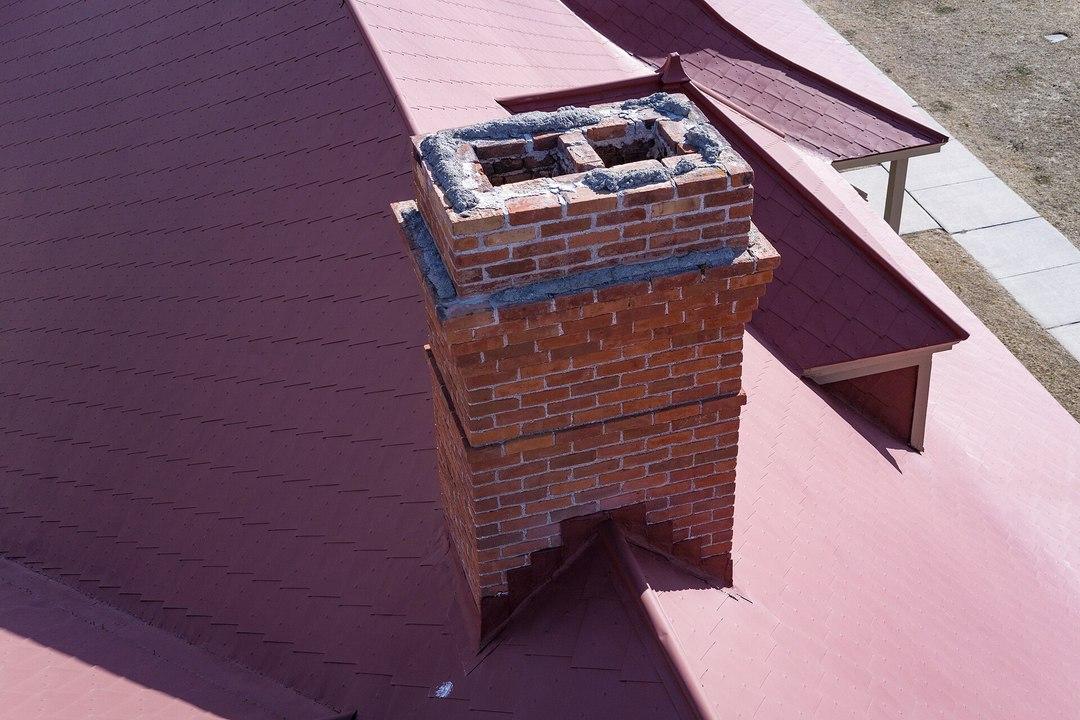
The part of the chimney nobody sees
The crown is the lid on the brickwork. Stand on the roof beside a masonry chimney and look down at its top: the flue tile sticks up in the middle, and the sloped slab of mortar or concrete running from that tile out to the edge of the brick is the crown. From the driveway it is invisible. That is why a quote for crown repair is so hard for an owner to judge, and why two contractors can propose very different jobs for it without either being challenged.
In Westminster two crown quotes reach us far more than any others. One says "seal crown." The other says "remove and replace crown." What follows is how to tell which your chimney needs.
Why a small slab matters
Everything below the crown depends on it. When it is whole, rain landing on top of the chimney runs outward and off. When it is cracked, water goes into the middle of the stack, between the flue tile and the brick, and works downward. The damage then appears somewhere else: mortar joints washing out a few courses down, white salt marks on the brick, rust on the damper, a damp smell from the firebox after a storm.
So crown trouble usually gets noticed as some other trouble. If you hold a leak quote or a masonry quote, the crown deserves a paragraph in it.
What sealing is
Sealing means brushing a thick, flexible coating made for the purpose over the whole top surface, once it has been cleaned and the cracks filled. The coating cures to a rubbery skin that gives a little with heat and cold.
It works when the crown beneath is still one solid piece: cracks that are narrow, no loose sections, no pieces missing, and the slab still gripping the brick below.
It does not work as a bandage on a crown that is breaking up. A coating bridges a hairline crack. It cannot hold together chunks that rock under a boot, and it cannot add slope to a top that was laid flat and ponds water.
What recasting is
Recasting means breaking the old crown away down to the top course of brick and forming a new one. Done properly, the new slab is thicker at the flue than at its rim so water runs outward. It reaches a little past the face of the brick so runoff drops free instead of streaking down the wall. And it is kept from gripping the flue tile, with a flexible joint left around the tile, because tile and crown heat up at different rates.
It is the right repair when the old crown is in pieces, when it was never more than a smear of leftover bricklaying mortar, or when the top course of brick beneath it has come loose and has to be relaid anyway.
How to tell which one you need
Photographs. A crown quote without close photos from the roof asks you to take the diagnosis on trust. These are the things we photograph, and what each points to.
- Crack width. Fine lines that a fingernail barely catches point to sealing. Gaps a coin edge fits into point to recasting.
- Movement. If any section shifts when pressed, the answer is recasting.
- Edges. A crown whose outer rim has crumbled back from the brick has stopped protecting the top course.
- Thickness. A slab that is thin at its rim was built light and tends to keep cracking.
- Slope. Water marks or a ring of dirt in a hollow mean the shape is wrong, and a coating will not change the shape.
- The brick beneath. Loose top-course bricks mean the job is bigger than the crown either way.
A Level 1 inspection at $175 includes those roof photos. If there are signs that water has already travelled down inside, such as rust at the damper or stains in the firebox, a Level 2 at $415 puts the camera in the flue to see how far it went.
What decides the price
Crown work has no list price with us, for the plain reason that the two repairs are nowhere near each other in labor. Each crown gets a written quote. The things that move it:
- Seal or recast, which is the largest factor by far
- The footprint of the chimney top, and whether one flue or several come up through it
- Whether top-course bricks need relaying
- The roof: height, pitch and how materials get up there
- Whether a new cap goes on at the same visit
On that last point, a cap is a separate item, quoted after we measure; size and material set the price. Crown and cap are often done together, because the cap has to come off for either crown repair and a crown without a cap above the flue is half a fix.
If you have a crown quote and no photos to go with it, tell us what it says through the form on this page, including whether it proposes sealing or replacement and whether anyone showed you pictures from the roof. We will explain what a second look would involve.
Where second looks find the difference
Crown quotes go wrong in both directions.
Too small: "seal crown" on a slab that is already loose. The coating looks fine for a winter. Then the pieces move, the skin tears, and water is back in the stack, now hidden under a layer that makes the cracks harder to see.
Too large: "replace crown" on a slab with two hairline cracks and good slope. The work will be sound, but the owner paid for demolition and forming that a coating would have covered.
And sometimes off target: the crown is fine and the water is coming in at the flashing or through an uncapped flue. When a leak is the real complaint, our published range for tracing and repairing it is $595 to $3,550, and the trace checks the crown along with everything else.
What a sound crown quote contains
Whoever writes it, a crown quote worth signing has a few things in it. Photographs taken from the roof, close enough to judge the cracks. A stated method, seal or recast, with the reason for choosing it. For a recast, how the new slab will be shaped and how the joint at the flue tile will be handled. A note on the cap. And a line saying what was found in the top courses of brick, even if the line reads "sound". A quote missing most of those is the kind we get asked to look at again.
Timing
Crown repairs want dry weather, so the coating can cure or the new slab can set. In Orange County that makes late spring through early fall the natural season. A crack found in January is often covered temporarily and repaired properly once the rain stops. Booking in the dry months also avoids learning about the problem from a ceiling stain.
Getting a second look at a crown
We photograph, seal and recast crowns in Westminster and in Fountain Valley, Huntington Beach and Buena Park. Head to the contact page, tell us what your quote proposes, and we will set up the roof visit.
Holding Paperwork That Says the Same?
Mulberry inspects the chimney, photographs every finding and then marks each line of your quote as needed, able to wait or unsupported. Visits run from Westminster to Fountain Valley, Huntington Beach, Buena Park and the rest of Orange County.